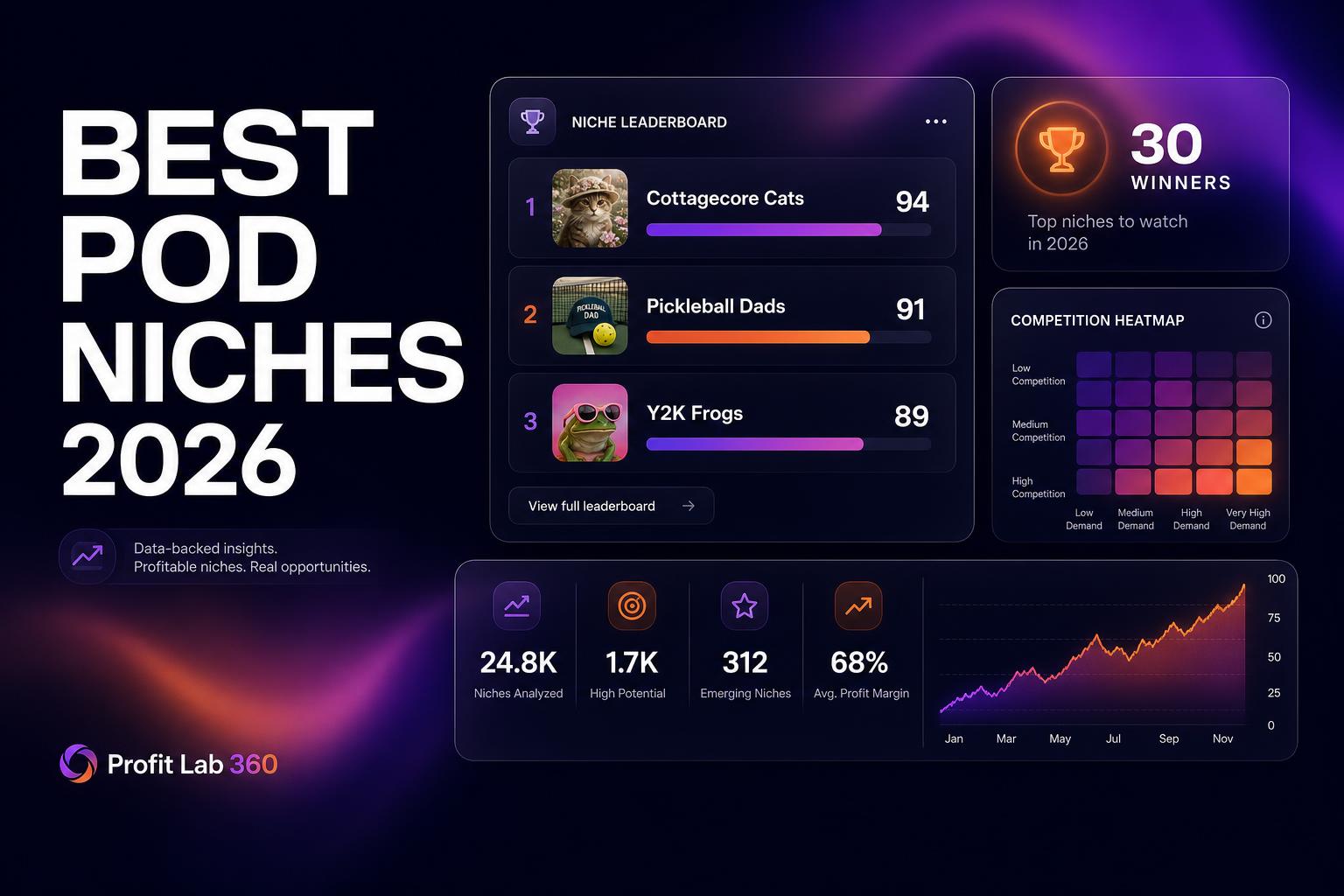
Picking a print on demand niche in 2026 is harder than it was three years ago and easier than it will be in 2028. The marketplaces (Redbubble, Etsy, Amazon Merch, TeePublic, Society6) are absorbing tens of thousands of new sellers every month, but the underlying buyer pool keeps growing too — and most of those buyers still type the same long-tail queries they did in 2019. The opportunity hasn't dried up. It's just moved into the cracks.
This guide is the niche shortlist we use internally at Profit Lab 360 to brief new sellers in 2026. It's not "trending right now" clickbait — those niches are dead by the time you read them. Every niche below has at least 12 months of stable or rising Google Trends data, a clear buyer persona, and at least one POD product format with proven sales velocity.
How we picked these niches
Each niche on this list had to pass four filters:
- Sustained demand — flat or rising 12-month trend, not a 30-day spike.
- Identifiable buyer — you can describe the customer in one sentence.
- Tag opportunity — top 20 on Redbubble missing at least 3 obvious long-tails.
- Multi-product fit — works on at least 3 product formats (sticker + shirt + poster, etc).
We ran every candidate through the live demand and saturation scoring inside our Redbubble Niche Finder before including it. If you want to vet your own ideas the same way, that tool is free to try.
1. Cottagecore + dark academia hybrids
The Tumblr-era aesthetics never died — they professionalized. In 2026 the buyer is a 22-30 year old who decorates a rented apartment and a digital workspace with the same visual identity. Mushrooms, moths, antique botanical plates, hand-lettered Latin phrases, candles, old books. Saturation on Redbubble is high on stickers but weak on hoodies and posters, which is where the margins live.
2. Mental health + neurodivergence (positive framing)
ADHD, autism, anxiety as identity statements — not jokes, not pity. The trend over the last 24 months has been from self-deprecating ("I can't even") to affirming ("My brain is just wired differently"). Demand on stickers and tote bags is steady; the gap is high-quality typographic posters with the same tone. Avoid clinical imagery, lean into warm illustrative styles.
3. Hyper-local pride (city + neighborhood)
"I love New York" is dead. "Brooklyn Heights map print" sells. The pattern works in any country: the more specific the neighborhood, the less competition and the higher the price the buyer will pay. Tourists buy national. Residents buy hyper-local — and residents are a bigger market than tourists for most cities.
4. Niche professions (the long tail of "for nurses")
"Nurse" is over-served. "Pediatric oncology nurse", "ICU travel nurse", "veterinary anesthesia tech" are not. The same applies to teachers (kindergarten Montessori vs. high school chemistry vs. ESL adult learners), engineers (civil vs. aerospace vs. firmware), and every trade. The deeper you go into the profession, the more loyal the buyer and the more they're willing to pay for a shirt only their colleagues would recognize.
5. Hobby tribes with insider language
Sourdough baking, disc golf, lockpicking, fountain pens, vintage Casio watches, mechanical keyboards, fly fishing, vinyl collecting, bonsai. These tribes have shared vocabulary that outsiders don't understand — which is exactly what makes a great POD design. "Levain", "ace", "EDC", "lume", "split keyboard" mean nothing to Google but everything to the buyer.
6. Pet breeds (specific, not generic)
"Dog mom" is saturated to death. "Mini Schnauzer mom" is not. Breed-specific designs convert 2-3x better than generic pet designs because the buyer self-identifies as their breed's person, not as a generic dog or cat owner. Same applies to rabbits, reptiles, parrots, and especially horses (every discipline — dressage, barrel racing, eventing — is its own niche).
7. Faith + spirituality (non-denominational + specific)
The two extremes work: very specific (Catholic saints, specific Bible verses, specific Buddhist concepts, tarot, witchy/occult) and very broad-but-modern (faith-adjacent typography, "blessed", "grateful"). The dead middle — generic Christian designs — is over-supplied.
8. Funny but smart (referential humor)
Pun shirts about a specific profession, fandom or sport. The bar in 2026 is high: the joke has to be specific enough that someone outside the in-group wouldn't get it. That's what makes the buyer feel seen. Generic "I do my own stunts" shirts are dead; "Bayesian statistics joke for grad students" is not.
9. Sustainable living + low-buy / no-buy
The buyer is paradoxical — they don't want to buy things, but they want their identity around not buying things to be visible. Tote bags, second-hand-shop apparel aesthetics, hand-drawn plant care guides, "buy less, choose well" typography. Small but high-loyalty market.
10. Indie sports + emerging Olympic sports
Breaking, sport climbing, surfing, skateboarding, pickleball, padel, gravel cycling, trail running. These have small but extremely engaged communities and very few good designs on POD platforms. Pickleball alone has grown 200%+ in the last 24 months and is still under-served on Redbubble and Etsy.
Where to NOT go in 2026
- Generic "dog mom / cat mom" designs — top 20 is impenetrable.
- Generic motivational quotes — buyer can't differentiate yours from 50,000 others.
- Holiday designs you start in October — too late, must be uploaded 90+ days out.
- Anything tied to a specific celebrity or movie — trademark takedown risk is real and costly.
- "Trending TikTok sound" merch — by the time you've designed it, the trend is dead and your listing is dead weight on your shop.
How to validate a niche before you design
Take any niche above and run these three checks in order:
- Open Redbubble, search the niche, sort by "Best Selling". Look at positions 4-24. If 4+ of them are amateur-quality, the niche has weak supply. Green light.
- Check Google Trends for the niche phrase over 5 years. Flat or rising = good. Decaying or a single spike = skip.
- Search the niche on Pinterest. If there are zero or one well-curated boards, demand is unmet. If there are 50+ over-curated boards, supply is already meeting demand.
For a deeper walkthrough of the validation loop see our guide to finding profitable Redbubble niches, or jump straight to the 20 lowest-competition niches with live data.
The honest closing
No niche on this list is a guarantee. The seller who picks niche #5 and ships 30 well-researched designs over 90 days will outperform the seller who picks niche #1 and ships 3 sloppy ones. Niche selection is necessary, not sufficient — execution is what compounds.
If you want the full picking-to-listing loop compressed into one workflow, start with our free niche finder, then move into the full studio when you're ready to design and list at scale.