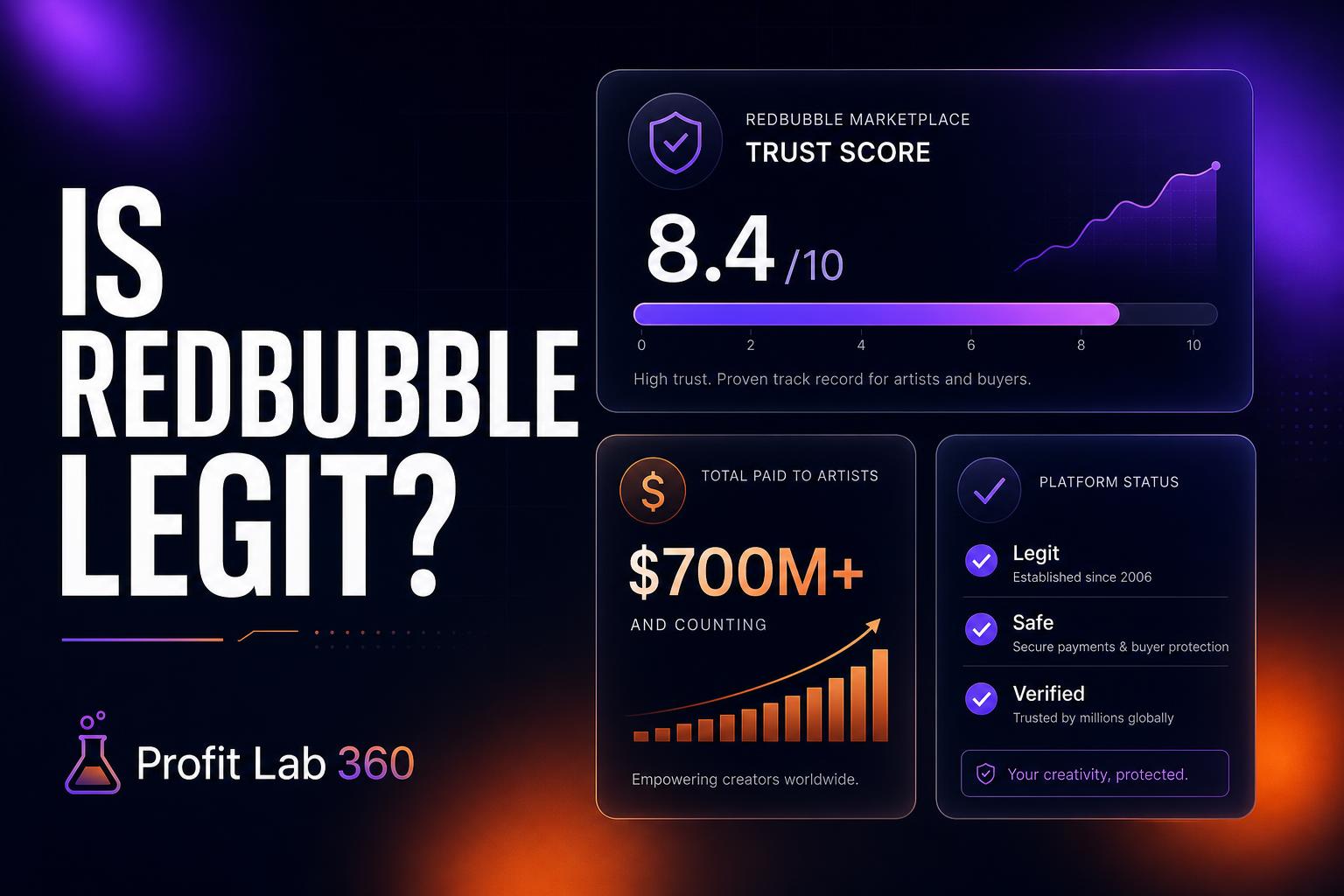
Short answer: yes, Redbubble is legit and safe. Redbubble is a publicly traded Australian company (ASX:RBL), founded in 2006 in Melbourne Australia, that has paid out more than $700 million USD in royalties to over 700,000 independent artists. Buyers receive real, high quality products; sellers receive real payouts. The Redbubble marketplace has flaws — we cover them honestly below — but it is not a scam.
Is Redbubble legit? Quick verdict
| Verdict | Legit and safe; not a scam, with known flaws |
|---|
| Company | Publicly traded (ASX:RBL), Melbourne, Australia, since 2006 |
|---|
| Paid to artists | $700M+ in royalties to 700,000+ artists |
|---|
| Payouts | 15th of each month, $20 minimum via PayPal |
|---|
| Sister site | Owns TeePublic since 2018 |
|---|
That said, "legit" is a low bar. The real questions for 2026 are: is Redbubble safe to buy from and to sell on, can you actually make passive income from it, are the products high quality, will your designs get stolen, and what do recent Redbubble news cycles change? Here is the full picture.
What is the Redbubble site? A quick primer
Redbubble is an online marketplace where independent artists upload their designs and Redbubble manufactures them on demand as a range of products: t-shirts, hoodies, stickers, phone cases, posters, tote bags, mugs and more. It is the print on demand category leader alongside TeePublic (which Redbubble also owns since 2018).
The Redbubble marketplace works in three steps:
- Artists upload their designs — any Redbubble artist can open a free shop, upload artwork, and choose which of the 70+ products the design appears on.
- Buyers browse the online marketplace — search and category pages surface designs by relevance, demand and recency.
- Redbubble fulfills the order — a partner factory in the buyer's region prints, packs and ships the high quality product, then pays the artist a royalty.
Headquarters are in Melbourne Australia, but the fulfillment network spans the US, UK, Germany, the Netherlands and 9 more countries — that is why shipping speed and quality products feel a little different depending on where you live.
Is Redbubble a real company?
Yes. Redbubble Group is headquartered in Melbourne, Australia, and has been listed on the Australian Securities Exchange since 2016. As of their last published annual report, the marketplace generated ~$390M USD in gross transaction value, fulfilled by a network of independent third-party manufacturers in 13+ countries (USA, UK, Germany, Australia, Netherlands and more). The company also owns TeePublic, acquired in 2018.
Is Redbubble safe to use? (buyers, sellers, payments)
Redbubble — is it safe to use day to day? The honest answer is yes — Redbubble is safe to use on both sides of the marketplace, and the platform is legit and safe in the ways that matter. The most common search queries we see ("is Redbubble a legit site", "is Redbubble safe", "Redbubble is it safe") all map back to the same five trust signals listed below. Here is what each group should know.
Is Redbubble safe to buy from?
Yes, with caveats every honest review needs to mention:
- Payment is secure. Stripe and PayPal process all checkouts. Card data never touches Redbubble's servers directly. This is the same payments stack used by most legit and safe online marketplaces.
- Products are real and shipped. Average buyer rating on Trustpilot sits around 4.0/5 across 50,000+ reviews. Sitejabber is lower (~3.6/5).
- The real complaints are quality variance and slow shipping. Because products are print-on-demand and fulfilled by third parties, quality depends on the manufacturer for your region. A sticker printed in the US Midwest and one printed in Germany can look slightly different. Standard shipping is 7–14 days; that is genuinely slow compared to Amazon Prime.
- Refunds and customer service are honored, but Redbubble's customer support policy requires photo evidence for quality issues and the process takes 3–5 business days.
Is Redbubble safe to sell on?
Yes — but the platform's economics in 2026 are tighter than they were in 2018. The legitimate, durable concerns are:
1. Royalties are real, but margins are thin by default
The default artist margin is 20%, which on a $19.84 t-shirt pays you about $3.97 per sale. Stickers pay $0.40–$1.20. Hoodies pay $6–$12. Phone cases pay $2–$4. It adds up for sellers who treat it like a business and ship 100+ designs; it does not produce full-time passive income from 5 random uploads. See which products earn the most in our breakdowns of best-selling Redbubble stickers and best-selling Redbubble hoodies, or calculate your exact margin with the free Redbubble fee calculator.
2. Payouts work
Payouts are monthly via PayPal (any country) or direct deposit (limited countries). The minimum threshold is $20 for PayPal. Late or skipped payouts are not a recurring complaint — when sellers do flag missing payments, they almost always trace back to an unverified tax form (W-9/W-8BEN) or an outdated PayPal email. This is the legit and safe behavior you want from a payouts pipeline.
3. The Marketplace Integrity team is strict — and that is mostly good
Redbubble actively removes designs that infringe trademarks (anime, sports leagues, Disney, music artists). Accounts with repeated infringement get suspended. Beginners sometimes call this "Redbubble stealing my work" — usually it isn't theft, it's a takedown because the design used a copyrighted character. The fix is for every Redbubble artist to upload their designs as original work. Our tag generator and niche finder are both built around trademark-safe original concepts for this reason.
Is Redbubble trustable? The trust signals that matter
Trustable is a stronger word than "legit". Here is the full trust stack we look at before recommending the Redbubble marketplace to a new seller:
- Public financials. Quarterly reports filed with the ASX since 2016. You can read the books.
- ~4.0/5 Trustpilot across 50,000+ reviews — a number you cannot fake at that volume.
- Documented payout cadence. Monthly, with public threshold ($20) and public schedule (15th of every month).
- Public DMCA workflow. 2–5 business days average response time, plus a Marketplace Integrity team that responds to artist reports.
- Independent artists own their IP. Redbubble's terms grant a non-exclusive license, not ownership — you can list the same artwork elsewhere.
Those five signals are why we consider Redbubble trustable for new sellers in 2026. If any one of them broke, our recommendation would change.
Will my designs get stolen on Redbubble?
Design theft does happen on every POD marketplace — Redbubble, TeePublic, Etsy and Amazon Merch all deal with bot accounts that scrape top sellers and re-upload at lower prices. Redbubble's response time on DMCA takedowns averages 2–5 business days, which is competitive for the industry. Practical mitigations:
- Watermark your portfolio images posted elsewhere (Pinterest, Instagram).
- Register original work with the US Copyright Office for $45 if it's a top earner.
- Use Redbubble's IP/Publishing reporting form, not just email.
- Ship many designs — a portfolio of 200 is harder to systematically clone than 5.
Redbubble news 2025–2026: what changed
Most "is Redbubble dying" Redbubble news threads exaggerate. Here is what actually changed in the last 18 months that affects sellers and buyers:
- TeePublic integration is deeper. A single Redbubble artist account can now sync to TeePublic faster, which doubles distribution without doubling work.
- Fee structure adjustment (2024). Redbubble reworked its service-fee buckets to flatten buyer prices in cheaper categories (stickers, magnets). Sellers who price at default margin barely noticed; sellers using high custom margins felt a small CTR dip.
- AI artwork policy tightened. Mass-uploaded, low-curation generative AI work is now demoted in search. Curated AI + human-edited work is fine and ranks normally.
- Search relevance rebuild. The search algorithm now weights tag quality and seller consistency more heavily — exactly why the 50-tag formula we teach in our tag generator matters more than it used to.
None of these are scandals. They are the normal evolution of a 19-year-old online marketplace.
Is Redbubble worth it in 2026?
Worth it for whom? Three honest answers:
- As a buyer: yes for unique designs you can't find on Amazon, with the expectation that shipping is slow and quality is occasionally inconsistent. Use the 1–5 star design ratings on each listing as a quality signal.
- As a hobby seller: yes. The barrier to entry is zero — no inventory, no upfront cost. Upload, tag, get paid. A small but real passive income stream after a few months of consistent uploads.
- As a business seller targeting $1k+/month: yes, but only with a systematic workflow — niche research before designing, SEO-optimized tags, 100+ designs in your shop, and cross-listing to TeePublic, Etsy and Amazon Merch. That's exactly what we built Profit Lab 360 for.
Redbubble vs the rest: where it sits in the 2026 marketplace stack
"Is Redbubble legit?" usually leads to the next question: is it the best place to sell? The honest 2026 answer is that Redbubble is one piece of a multi-marketplace stack, not the whole stack. Here is how it compares on the variables that actually move revenue:
- Redbubble vs TeePublic. Same parent company, slightly different buyer base. TeePublic skews younger and more apparel-heavy; Redbubble skews broader (stickers, posters, home goods). Cross-list to both — TeePublic's bulk uploader makes this nearly free once your Redbubble shop is mature.
- Redbubble vs Etsy. Etsy has 4× the traffic but charges $0.20 per listing plus 6.5% transaction fees, and you provide the print partner (Printify, Printful, Gelato). Higher margin per sale, much more operational work. Redbubble handles fulfillment; Etsy doesn't.
- Redbubble vs Amazon Merch on Demand. Amazon's traffic dwarfs every POD marketplace combined, but Merch is invite-only with tier limits (10 designs at Tier 10, scaling to 8,000+). Redbubble has no gate — anyone can upload day one. The smart play is Redbubble + TeePublic while you wait for Merch approval, then a winner gets re-listed on Merch.
- Redbubble vs Society6. Society6 pays artists a flat 10% on most products vs Redbubble's adjustable margin. Better fit for premium wall art and home decor; worse for stickers and t-shirts.
- Redbubble vs Spreadshirt / Threadless. Both have smaller buyer pools but lower competition per upload. Worth cross-listing once your portfolio is 50+ designs.
Read our marketplace comparisons for the full per-product royalty math.
How much money do real Redbubble sellers actually make?
Public income reports from established Redbubble artists in 2025–2026 cluster into three honest tiers:
- $0–$50/month: the first 3–6 months for nearly everyone. Portfolio under 50 designs, no niche research, default tags. This is where most "Redbubble doesn't work" posts come from — it does work, the seller just stopped before the algorithm had enough signal.
- $100–$800/month: sellers with 200–500 curated designs, niche research baked into every upload, complete 50-tag listings. 9–18 months of consistent uploads.
- $1,500–$10,000+/month: full-time sellers with 1,000+ designs, paid Pinterest or Etsy ads driving external traffic, and cross-listing to TeePublic, Etsy, and Amazon Merch. 2+ years of compounding work.
None of these are guarantees. Redbubble is a real business: portfolio size, niche selection, SEO discipline, and consistency over years are what separate the tiers.
Common Redbubble seller questions, answered honestly
How long until my first sale?
Median first sale arrives 2–8 weeks after the first upload, depending on niche. New Redbubble shops also receive a small "new seller boost" in search for the first 30 days — use it by uploading 20–30 designs in your first two weeks, not 3.
Does Redbubble pay on time?
Yes. Payouts ship on the 15th of every month for the prior month's earnings, as long as your balance is over $20 (PayPal) and your tax form is on file. Late payouts almost always trace to an unverified W-9/W-8BEN.
Can I delete my Redbubble account if I change my mind?
Yes. Account deletion is self-serve in account settings. Pending earnings under $20 are forfeited (the same threshold rule applies). Your IP reverts fully to you — the license you granted Redbubble is non-exclusive and tied to your active account.
What's the single fastest way to grow on Redbubble in 2026?
Niche depth, not design volume. A seller with 50 designs across 3 well-researched niches outperforms a seller with 500 designs across 50 random niches. Our niche finder is built around exactly this constraint.
What sellers usually mean when they call Redbubble a scam
Almost every "Redbubble is a scam" thread on Reddit, when you read past the headline, boils down to one of three things:
- A trademark takedown that removed a design — legitimate enforcement, not theft.
- Low sales after uploading 5 designs in a saturated niche — a math problem, not a platform problem.
- A specific bad print or slow shipment — real, frustrating, but isolated and refundable through customer support.
None of these make Redbubble a scam. They do mean expectations need calibration.
The bottom line: is Redbubble legit and safe?
Redbubble is a real, regulated, publicly traded marketplace that has paid out hundreds of millions to independent artists. It is legit and safe to buy from and legit and safe to sell on. The platform isn't a get-rich-quick scheme — it never was — but for sellers who treat it like a business and do the niche, SEO and design work, the Redbubble marketplace remains one of the most accessible print-on-demand marketplaces in 2026.
Where to go next: niche research hubs by marketplace and product
Once Redbubble is set up, the fastest revenue lift comes from layering on the right second marketplace and the right product format. Start with the niche research hubs that match where you want to grow:
If you want to skip the trial-and-error and start with niches that already have demand and low saturation, run our free niche finder — three vetted niches in under a minute, no credit card.