IdeasPublished 10 min read
Print on Demand Ideas: 8 Systems That Beat Listicles in 2026
Eight repeatable systems for generating POD ideas that haven't been copied to death — and the validation check to run before designing.
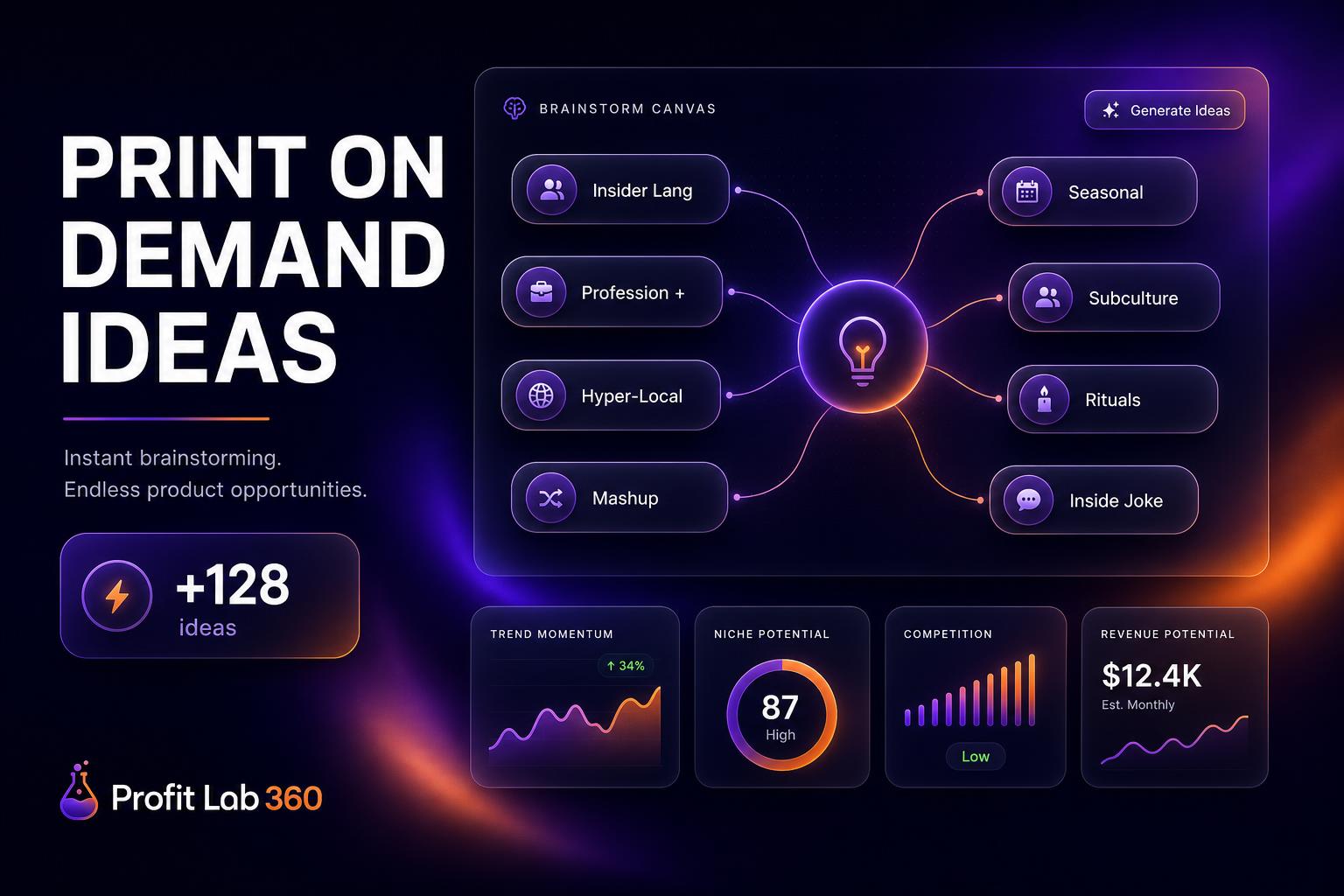
Eight repeatable systems for generating POD ideas that haven't been copied to death — and the validation check to run before designing.
Most "print on demand ideas" listicles are useless. They give you 100 designs to copy, which means by the time the post ranks, 100,000 other sellers have already copied them. This guide does the opposite: it gives you a small number of idea generation systems you can apply repeatedly to come up with designs that haven't been done — or haven't been done well.
Every system below has been used by sellers running 6-figure POD businesses. None of them require artistic talent. They require noticing — paying attention to where buyers signal an identity that hasn't been turned into merch yet.
Every tribe has vocabulary outsiders don't understand. Bread bakers say "levain" and "ear". Disc golfers say "ace" and "Roc". Mechanical keyboard fans say "thock" and "endgame". This vocabulary is the entire moat: a shirt that says "endgame" with a stylized keyboard sells to a buyer who self-identifies as part of the tribe, and only that buyer.
How to use it:
"Nurse" is saturated. The 30+ specializations of nursing are not. Same with teachers, engineers, lawyers, designers, accountants, every trade. The deeper into the specialization you go, the higher the buyer loyalty and the less competition.
How to use it:
Example: "Nurse" → "ER nurse", "ICU nurse", "pediatric oncology nurse", "labor & delivery nurse", "psych nurse", "school nurse", "veteran's hospital nurse", "hospice nurse", "flight nurse", "travel nurse". Each is a separate design family.
"I love New York" is dead. "Park Slope, Brooklyn" is not. The pattern works at every level below national: state, region, city, neighborhood, school district, local landmark, local food, local sports team below MLB/NBA/NFL.
How to use it:
Residents are a bigger market than tourists for most cities, and they're not over-served.
Generic "dog mom" merch is dead. Breed-specific merch is alive and well — buyers self-identify as their breed's person, not as a generic pet owner.
How to use it:
The strongest POD designs answer one question: what does the buyer want strangers to know about them? Identity statements work because the buyer isn't buying art — they're buying a public statement.
Modern identity statements that convert in 2026:
Almost every profession, hobby and tribe has its own calendar of events. Marathons, conferences, conventions, exam dates, award seasons. These are deadline-driven gift purchases.
How to use it:
Major life transitions are merch moments: pregnancy, new parent, retirement, graduation, promotion, kids leaving for college, divorce, recovery milestones, weight-loss milestones. The buyer is in an identity-shift and merch that names the shift sells.
How to use it: design for the specific transition, not the generic role. "Soon-to-be NICU mom" outperforms "mom". "10 years sober" outperforms "sobriety".
Take two unrelated tribes and combine them. "Sourdough + statistics jokes". "Disc golf + dad bod humor". "Mechanical keyboards + medieval history". These hybrids are almost always under-served because no individual seller would think to combine them — and the buyer who belongs to both tribes feels uniquely seen.
Not sure which product format fits your idea? Check what already sells in our best-selling mug designs, hoodie designs and tote bag designs.
Before you spend a single credit on design, run the idea through the basic 3-step check:
Ideas are not the bottleneck — execution is. The seller who applies one system above to generate 20 design ideas, validates the top 5, and ships them well over 30 days will outperform the seller who has 200 ideas and ships nothing.
Some hard-earned execution rules:
If you want a turnkey idea-to-listing loop:
The systems above don't expire. Marketplaces change, trends die, but "find specific buyers with insider language and unmet supply" is the same playbook in 2026 as it was in 2018 — and it'll be the same playbook in 2030.